Tag

our story

October 6, 2021

The Four Rules of Planning – (Podcast Ep.1)

Listen on Apple Podcasts or Google Podcasts

You want to start getting organized around the things that matter most to you. But where do you even begin?

In our first episode, we offer an effective shortcut for diving into the world of time-management and productivity—without getting overwhelmed. Listen above or on Apple Podcasts or Google Podcasts

Our “Four Rules of Planning” —

  1. Write down what you did. For several days or weeks, use your planner to record what you did. By starting with the rhythms and habits you already operate in, you can recognize patterns, and evaluate what’s working and what’s not. You can then design incremental change that serves your family, makes sense for the season you’re in, and builds into a sustainable lifestyle. 
  2. Build your repertoire of planning skills. Think about it like becoming a skilled cook in a kitchen. You must build your planning and productivity skills over time, as you come upon new challenges. Learn as you go, practice patiently, and you’ll soon feel equipped to adapt your new skills to fit any given situation. Just as a skilled cook would not feel the pressure to use every technique they know every time they prepare a dish, you shouldn’t feel the pressure to exercise every single time-management or efficiency muscle you have every single moment of every day. You simply build your repertoire of skills for when you need them.
  3. Train your subconscious. The more you write down your goals and priorities, the more you are teaching your brain to focus on what is important to you. This builds a “working memory” around your priorities, enabling you to waste less energy on deciding what you need to do next in the day-to-day, so you can give more brain space to bigger goals and projects.
  4. Maintain a flexible mindset. Even with the best planning, life still throws punches and things play out in ways you could’ve never anticipated. Instead of mislabeling yourself as “failures” because of circumstances out of your control, you have the choice to strengthen your positive influence in any given situation. You can take a proactive approach to these challenges—whether big or small—by adopting a mindset that inspires you to pivot and handle the inevitable changes to your plans in creative and life-giving ways.

Cozy up with this first episode, & you’ll hear:

  • A little about team Evergreen and our heart behind starting this podcast
  • Our shortcut for understanding and getting organized around your unique dynamics
  • A practical tip that helps you shift your mindset from never feeling like you’re doing enough
  • How planning is a lot like cooking—and how learning on the go is a super-effective approach

We’ll be back with The Four Rules of Planning – Part 2 next week!

Please rate & review the podcast!

It does so much to help other women discover the show.

______________________________________

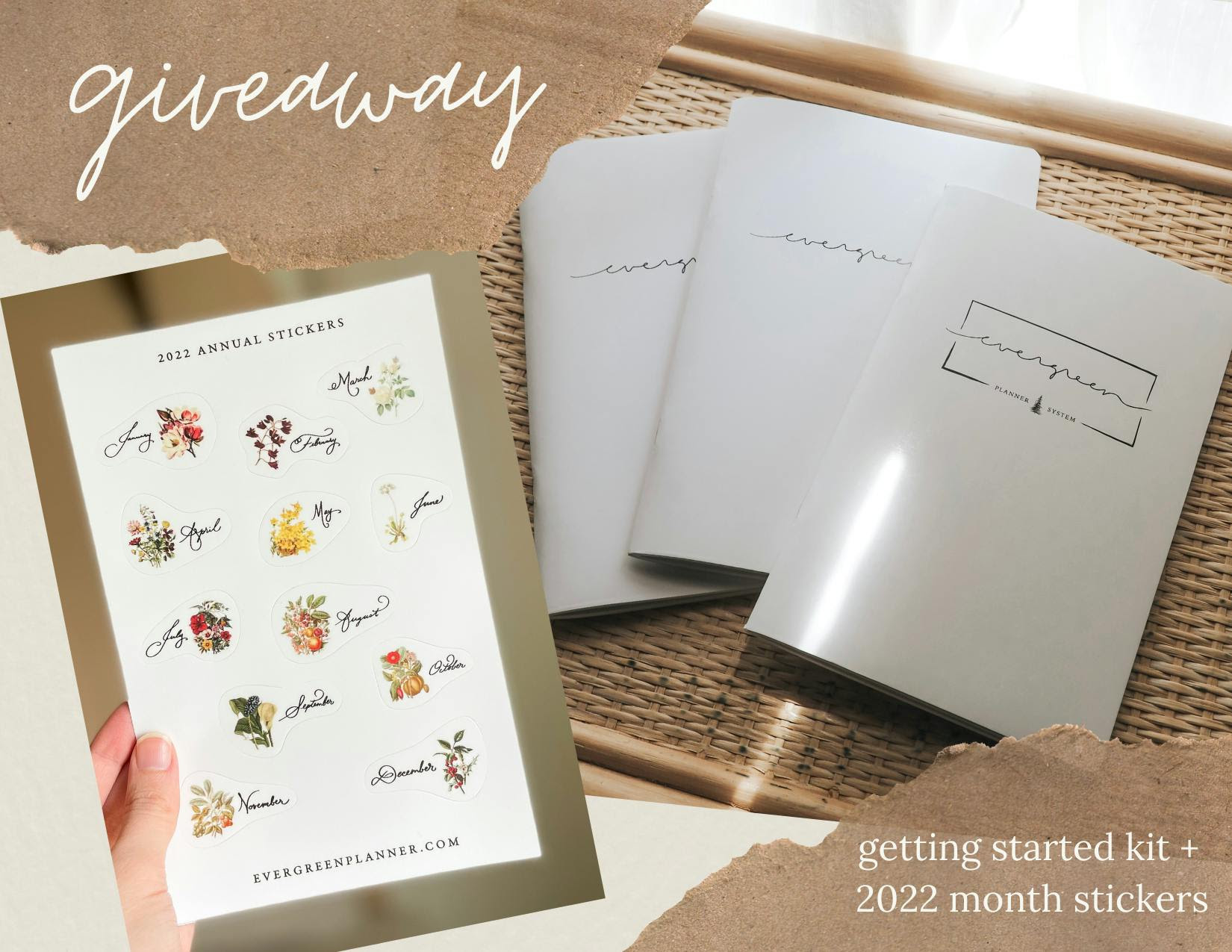
To celebrate the launch of our podcast, we are giving away a Getting Started Kit (our Annual and two Monthly booklets) + our brand new 2022 Month stickers! Write a review by Friday (Oct 8, 2021) and email a screenshot of your review to helloevergreenplanner@gmail.com to enter the giveaway!

Follow us also on Instagram @EvergreenPlanner (there are ways to enter the giveaway there, too!) and Pinterest @helloEvergreenPlanner.

September 29, 2021

Self-Compassionate Planning + We’re Launching Our Podcast!

Planning, Pressure & Shame

When we launched our business in 2019, something caught us off guard. After years of field-testing different prototypes with ourselves and friends, we finally had our planner system on the market. The planner had become an indispensable part of our own lives, and we wanted to get it into the hands of others. Orders poured in and we were thrilled to see how other women would use this tool to fuel their goals.

But then we started getting emails and messages from women wanting to know how we thought they should spend their time. They weren’t just wondering whether they were doing this planning thing right—they were wondering if they needed to overhaul their entire lives in order to justify having bought a planner in the first place. These women were feeling both pressure to make perfect plans and shame when their days turned out differently than they imagined. Some were even feeling weighed down by the perception that their planner should look beautiful, even in the midst of their planning.

Now, don’t get us wrong, we’re down for an artful planner spread any day. And we believe there is so much to be learned from the planning community–hacks, tricks, best practices, etc. But we don’t believe that intentional living—and planning as a means to form an intentional life—has to be laden with pressure and shame. We believe quite the opposite.

Using a planner is not about super-womaning our way to an awesome life, or about forcing those around us to bend their lives to make our dreams happen. It’s not always about making a lot of money, or reaching an impressive personal goal, or cramming our life as full as it possibly can be. It’s not about making inflexible plans that don’t adapt as we go.

But we also know that giving up all of our power to be proactive is a sure path to overwhelm. We believe planning is about forming a rhythm that leads to a lifestyle that fuels realistic and life-giving goals, so that those goals can in turn breathe life into your rhythms. We’ve found this is only possible if you take a self-compassionate approach to planning.

What is self-compassionate planning? It is making the best plans you can—consistently over a lot of days—and yet having grace on yourself as you go, knowing that plans do change and that flexibility is key.

Friend, we don’t know your biggest dreams, your biggest pain points, or the goals you’ve set for yourself this year. But we’re excited to put the Evergreen Planner in your hands as a tool that you use to reach those goals.

And as for a self-compassionate mindset?

Well, we’ve got something for that too.

Our Podcast

We’re passionate about helping women craft intentional lifestyles that empower them to achieve their most life-giving goals. When our team gets together to support each other, we end up having these amazing conversations that encourage each of us to stay focused on the things that matter most.

So we decided to throw up some mics so we could share our conversations with you.

On October 4th, 2021 (that’s this Monday!), we’re launching our podcast: Make Space to Thrive.

Self-compassionate planning

Our first season will run for eight episodes, and will be available on all the major platforms.

We’ll be talking about our four rules of planning, taking a deep dive into our R.O.O.T.E.D. goals system, discussing planning while postpartum, how we plan our days & weeks and so much more. We’re so excited to share all we have learned and are learning with you all. But more than anything, we’re excited about taking some of the pressure off, and bringing encouragement to the wonderful women we have met since launching our business. This podcast is for each of you, from our hearts.

xx,

Team Evergreen

_________________________________________

Did you know you can try a piece of the Evergreen Planner system toady for free?! We want every woman to have the tools she needs to be able to begin planning intentionally, which is why we’ve created a free day planner sheet that has all of the major features of our Monthly booklet. Check it out!

March 10, 2021

Do You Know Your Productivity Personality?

Despite ourselves, we are pretty big fans of personality research. I think both of us have tried to quit the whole personality-test scene about a dozen times, but we keep coming back to it.​

Truth is, we know that God loves diversity, and has built it into His Creation in some pretty astonishing ways. One of the most interesting, delightful, and sometimes confounding ways is the diversity of human personalities.

Within the boundaries of healthy ethics is a vast array of valid differences in which individuals perceive, engage, and respond to the world around them. Observing these differences, naming and cataloguing them, and then discussing them in light of God’s Word is work that seems to fall along the same lines as what Adam started doing with the animals in the garden. Only, unlike animals, God has put eternity in our hearts, and so our psyche is impossible for humans to fully comprehend and define. But to us, that truth only serves to magnify the intrigue of personality science. So we keep on discussing all of these significant differences in order to cultivate understanding, cooperation, and fruitfulness across the board.

We also research these things in order to better understand our own tendencies, identify any needs we’ve been ignoring, address personal weaknesses, tap into our core motivations, and better leverage our strengths.

Just like learning your top Love Languages can help you build into your marriage, or pegging Enneagram numbers can help you better respect your friends, learning your Productivity Personality can really help you begin to develop the most effective conditions in your home, office, and team systems for getting things done.

Working Personality

In his immensely practical book, The Synergist, Les McKeown outlines three types of people on your average working team:

  • the Visionary: this is the person who is constantly imagining ways to get to the next level
  • the Operator: this is the person who is consistently getting things done
  • the Processor: this is the person who obsesses over the systems that make everything work sustainably

Most of us have a dominant trait, and then a secondary one. And, like anything else, every type has strengths and weaknesses.

For instance, Shelby is a Visionary-Processor. She is always seeing the bigger picture, and then feeling the urge to create some kind of list or calendar or habit to get the team from A-Z. The problem is, all the ideas and systems she produces aren’t always super realistic without a lot of healthy feedback to tame them into something doable. It’s also easy for her to feel irritated that the letters B-Y are full of a lot of minutiae that distract from the initial burst of inspiration or the ending triumph of accomplishment.

McCauley is an Operator-Visionary. Getting stuff done and then dreaming about the next big goal are both her native language, but she can often feel overwhelmed by not being able to see how everything is working together to a single strong end. She never questions the amazing possibilities, but she does tend to tame Shelby’s chomping-at-the-bit to up-level with the same serious question: “But have you finished this other vital task?”

McKeown’s book urges the reader to identify their own working personality and the personalities of the other influential people on their team, and to understand the various strengths and weaknesses, and the ways that each personality can clash. The goal of all of this inner-work is to become what he calls a Synergist: someone who is realistic about the team’s dynamics, can patch personality holes when hiring, can work to resolve conflict, and can weave the team’s various strengths into a singularly powerful force.

After Shelby read this book in 2019 and we examined the Evergreen team dynamics, we began praying that we could find a Processor-Operator to join the team. We knew that pulling another Visionary on the team could serve to drown out McCauley’s common-sense approach that wanted to see the results that come from consistency before jumping into a new strategy. We also knew that my hankering for organization and sustainability would solve the overwhelm problem—so long as the systems we created were actually practical. We also knew that a mere Processor (without an Operator wing) would bog us down a bit too much with systems, without having that can-do, problem-solving spirit that our tiny startup needed from every single member on our founding team.

Not too long after, Shelby was having a conversation with Clari at a family reunion (fun fact: she’s my husband’s cousin by marriage), and she mentioned that she was a Virtual Assistant. Something was seriously clicking. After an interview and trial run, we quickly realized that she was the Processor-Operator we’d been praying for.

Knowing your working personality is useful for so much beyond just hiring. It can be useful in any working relationship. Knowing that McCauley is an Operator has helped Shelby make sure that she included progress updates in team meetings. Knowing that Shelby is a Visionary has helped McCauley understand that Shelby’s not flaking out on the here and now—but that she’s hardwired to be envisioning what’s next. She also has learned that I’m a well of ideas that can be tapped at any time with a single question—and McCauley is always there to help Shelby prioritize the next best idea.

Knowing your working personality can also help you identify your personal weaknesses so that you can stop spinning your wheels.

Shelby was able to identify that she didn’t have many Operator tendencies. This meant that while she was a natural at reverse-engineering huge goals, it was really tempting for her to try to skip the consistent effort necessary to turn those goals into a reality. So she started to create planning habits that helped her focus on action over more strategizing. She started to use her planner to record “tada lists” (things that I got done) instead of just todo lists, as a way to spur herself into doing what she knew was needed. She also started to be honest about her tendencies to procrastinate follow-up and project completion, to eliminate distractions that limited significant progress, and to reach out to others for accountability.

But even while building these essential habits, Shelby also fed her inner Visionary-Processor by listening to podcasts that stretched her imagination, externally-processing dreams with certain designated people, and giving herself permission to flesh out new ideas for the future when the time was right.

So how about you? Take this incredibly simple quiz to gain more insight on your productivity personality.

Then, take time to journal through the following prompts:

  • How can you mitigate weaknesses through intentional planning habits?
  • How can you feed your strengths?
  • What strengths does your team have? Who do you need to hire?

_______________________________________

Today is the last day to purchase our Q2 subscription box! We ship our sub boxes four times a year and they contain 3 Monthly booklets along with curated planning accessories. The Monthly is the muscle of our planning system. It’s a five-week undated day planner featuring week spreads, habit trackers, timeblocked day pages, and plenty of bullet grid flex space to make the planner completely yours. We can’t wait to see what you do with the right tools in hand!
January 6, 2021

How R.O.O.T.E.D. Goals Can Help You Thrive in 2021

I (Shelby) recently asked a very creative, capable, hard-working woman how traditional goal-setting methods had failed her in the past.

She answered and said that traditional goal setting methods failed to help her make a bridge between the accomplishment of her most important goals and the life she was actually living in the present.

I could completely relate to those feelings.

Last week we told the story of how I plowed through stacks of time-management books, articles, and podcasts a few years ago when I found myself absolutely overwhelmed with the demands of working full-time hours from home, first-time motherhood, and chronic illness.

I learned so much from the top gurus in the time-management, goal-setting and personal growth habits space. But one thing I started to notice was that many of the tips and strategies assumed something that I couldn’t relate to—they assumed that I’d be able get away to a kid-free office for eight hours per day and take twenty minutes before or after work to think, strategize, and walk through my goal-setting rituals. I began to realize something important. If I had any hope of truly taking action on anything I was learning, I would have to transpose all of these amazing CEO strategies into my real life context—toddler-crowded, macaroni-stained, cartoon-clanging kitchen “office” and all.

I also learned something extremely important after doing one particularly invigorating goal-setting exercise that fell flat in about three weeks. As good as I was at dreaming big and reverse-engineering my goals from A-to-Z, I couldn’t set arbitrary goals and hope to have the stamina to meet them. Unless I found a way to integrate my long-term goals with my family’s daily good, my goals were shot. I just couldn’t stand to poke my head up from my goal-executing-scramble and see my little family starving for my time and attention.

The verdict was in. If it was going to be a contest between my paper goals, and my real, living, breathing heart goals (which were represented by my closest relationships, the atmosphere in my home, and the unexpected needs of others in my local community)—the paper goals were going to lose every time.

But I knew that I was called to more than just reacting and responding to the urgent expectations, requests, and whims of the people in my life. I was called to be proactive, to initiate, to solve big problems, and to make space for the important things. I could envision ways to cultivate abundance in the gaps of life where no one else could. I was put here for a purpose, and I wanted to keep growing into that God-given potential.

I knew that goal-setting could help me level-up from the realm of wishful thinking and begin to make the changes (big and small) that would empower me and my family to truly thrive. But I also knew from experience that S.M.A.R.T. goals weren’t going to cut it.

The deepest currents of our lives that needed my proactive and steady nurture in order to be routed into something that gave us life (instead of drowning us in the overwhelm of it all) propelled me far past the bare mechanics of goal execution. I needed to cut back the layers of excuses and get to the heart of my “why” for living intentionally and setting significant goals for personal and familial progress. The bridge I built between my future goals and my current life context needed to be suspended by the things that were actually essential to a life well-lived.

This deep dive into my core values resulted in the development of a completely new approach to goal-setting. Instead of inadvertently introducing a contest between my goals and the “obstacles” of my life, I crafted the lifestyle that I and my family craved THROUGH the goals I set and accomplished. In turn, our new lifestyle made so much space for personal growth and productivity that it’s actually begun to fuel some of the most challenging and life-giving goals that I’ve ever dared to imagine. 

​And here’s the key: Sustainable, Game-Changing, Life-Giving Goals are…​