
Author

Clari Mercier

October 27, 2021

How We Plan Our Days – (Podcast Ep. 4)

Listen on Apple Podcasts or Google Podcasts.

Before the Evergreen planner system, I (Clari) had never used a true day-planner. I had tried a myriad of different planners when I worked as an executive assistant before having kids, but they were the types that only had a small box, a column, or a couple of lines for each day. I also used a digital calendar to coordinate meetings and make sure nothing was double booked, but other than getting binged with meeting reminders, I didn’t really reference it or use it to effectively plan my days. My thoughts, plans and tasks were scattered among digital notes, emails, sticky notes, a half-used planner and to-do lists written on random pieces of paper.

But then I became a mom and quit my traditional job. It never occurred to me that a planner could be used to plan rest, to form life-giving family rhythms, or to plan intentional time with my kiddos—just as much as it could be used to make sure critical work projects or mundane home tasks were completed. I again wandered through my days doing what was in front of me, and working off one endlessly long to-do list.

Annie Dillard, in her book The Writing Life, wrote, “How we spend our days is of course how we spend our lives. What we do with this hour and that one is what we are doing.”

The reality is we have a lot of agency over whether we live our days intentionally, with purpose, or whether we let them pass by, moving from task to task based on emotions or a crushing sense of urgency. But we can just as easily fall into the trap of trying to squeeze every moment of productivity out of each day, neglecting our needs for rest or even the ones we’re called to love. But in order to find that middle way, we have to begin by planning each day.

The beauty of planning each day (especially when you have an entire spread and can plan with the context of your week in view, like you can with our Monthly booklet), is that you are able to plan each day in a way that honors the season you’re in, the ones you’ve been given to love, and the work you’re responsible for.

And planning a lot of days, over several weeks and months, enables you to begin forming life-giving rhythms that work to breathe life into your family and help you make progress on those bigger goals (revisit our Four Rules of Planning and R.O.O.T.E.D. Goals episodes for more on these concepts).

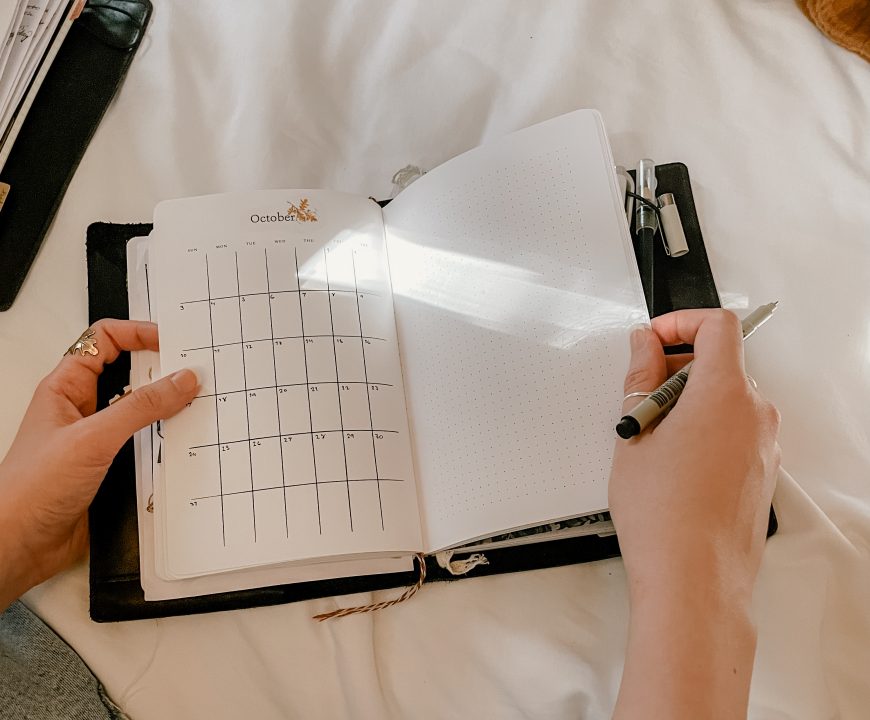
In this episode, we walk through how we each plan our days on the day pages of our Monthly booklet. If you’d like to follow along, you can download our free printable below. This printable has all the major elements of our Day page, enabling you to see exactly what we are talking about as we plan the different elements of our day using the time-blocker, top targets, prompts, etc. Because it’s the tool we each use, we talk about our specific planner throughout this episode. However, the principles we talk about can transfer to a lot of different planners, so whatever planner you use, we believe this will be an episode you find valuable!

_________________________________________________

If you haven’t yet, please take a moment to rate and review this podcast or share it with a friend! It’s the best way to help other women find this life-giving content. We’re so thankful for you!

October 20, 2021

R.O.O.T.E.D. Goals: A Refreshing Approach – (Podcast Ep. 3)

In typical goal setting culture, the mantra often goes something like this… “Girl, it’s time to change your LIFE. Close your eyes, imagine what you want your life to be like in five years—the sky’s the limit!—and write down your biggest dreams. Now reverse-engineer those dreams into a million baby steps, and do not stop hustling until you make those goals a REALITY. If you really want something, you’re going to have to get up crazy early, change your habits, and become a different person. You’re going to have to set the people in your life straight, too. They’re either going to have to get on board, or get out of the way. Aren’t your goals worth it? And if you start feeling discouraged—because those days will come (it is lonely at the top)—you’re just going to have to make sure you have a solid “why” to pull you through. So give yourself a kick in the pants, and get to work.”

It’s…. a lot.

The problem with this? Well, for starters, you can’t fully foresee the future. You cannot comprehend the very real tradeoffs for the goals you create on paper. Oftentimes, you’ll get into the thick of it and start to wonder how you can know if your goal is truly worth it. You feel a rising tension between living intuitively and following through on the goals you set.

Here at Evergreen, we believe that this tension is a real problem for women who seek to live intentionally. And we don’t think that laziness, lack of motivation, or even poor time-management is really at the root of the problem. We believe the problem is that people are setting goals that don’t line up with their real life.

A bad goal setting system—one that doesn’t take into account the context of your actual lived life—will lead to guilt and frustration because those goals can’t be sustained by your daily life. 

But creating goals and dreaming about a different future is good. Goal-setting helps us level-up from the realm of wishful thinking and reactionary living, and begin to make the changes (big and small) that empower us and our families to truly thrive. But the key is this: your daily life has to be able to sustain your goals, so your goals can in turn breath life into your daily life.

We believe there is a better way to set goals; goals that are sustainable, produce change, and are life-giving. We call this process setting R.O.O.T.E.D. goals.

Listen on Apple Podcasts or Google Podcasts.

ROOTED Goals are:
  • Rooted in your core calling Grasping the unique calling of God for your individual life is a process. But leaning into your core calling is an essential part of creating goals that fully resonates over the long-haul, compel you to follow-through in the execution of them, and produce a lot of satisfying fruit along the way. The soil of your core calling forms a rich environment for setting sustainable, healthy goals that actually energize you.
  • Organically growing out of your context You need goals that take your real life context seriously and embrace it. You need goals that connect with where you are right now, and that respect that you’re here for a reason. Recognizing the season you’re in and identifying the contours of your priorities can empower you to identify the next right step—the one that can realistically begin to build the lasting change you want to see.
  • Outlined for clarity (part 1 & part 2) – Clarity is QUEEN when it comes to giving your brain an objective that it can actually process, prioritize, and tackle in the day-to-day. When you break down a goal into tangible action-steps, you are equipped to move past your vague theories about what it will take to make your goal happen. You’re able to see the gaps in your knowledge about the process, which compels you to research until you have concrete and actionable understanding.
  • Tailored to your lifestyle If you want to craft compelling goals that are grounded in your unique calling, then you’ll have to give yourself permission to develop creative solutions that make sense for your particular circumstances. On the flip-side, you’ll also need to make some strategic adjustments to your lifestyle so that it actually supports and fuels your goals. (Having a strong sense of clarity will massively help with this.)
  • Etched into your memory For a goal to be sustained in the long-run, it has to stay top of mind. Writing your goal out daily and keeping it in sight will begin to train your subconscious to recognize the opportunities you have to make progress on it. 
  • Developed by Providence The R.O.O.T.E.D. Goal-Setting System reminds us that the Kingdom of God does not rise and fall by our efforts—but that we do have the responsibility to do our part, exercise our influence, and steward our resources. When we give our goals back to God, we know we can trust Him to develop them in the best of ways. 

Setting a R.O.O.T.E.D. Goal is all about creating a symbiotic relationship between your daily life and your goals. It’s about creating space for personal growth, and channeling your productivity in a way that cultivated peace. With this system, you can start to craft a lifestyle that not only sustains but actually fuels the vision that God is growing in your heart.

October 13, 2021

The Four Rules of Planning Part 2 – (Podcast Ep. 2)

In our second episode, we dive into the final two rules of planning: train your subconscious and maintain a flexible mindset. These concepts are simple to implement, yet extremely effective for crafting an intentional lifestyle. Listen on Apple Podcasts or Google Podcasts.

Our “Four Rules of Planning” —

  1. Write down what you did. For several days or weeks, use your planner to record what you did. By starting with the rhythms and habits you already operate in, you can recognize patterns, and evaluate what’s working and what’s not. You can then design incremental change that serves your family, makes sense for the season you’re in, and builds into a sustainable lifestyle. 
  2. Build your repertoire of planning skills. Think about it like becoming a skilled cook in a kitchen. You must build your planning and productivity skills over time, as you come upon new challenges. Learn as you go, practice patiently, and you’ll soon feel equipped to adapt your new skills to fit any given situation. Just as a skilled cook would not feel the pressure to use every technique they know every time they prepare a dish, you shouldn’t feel the pressure to exercise every single time-management or efficiency muscle you have every single moment of every day. You simply build your repertoire of skills for when you need them.
  3. Train your subconscious. The more you write down your goals and priorities, the more you are teaching your brain to focus on what is important to you. This builds a “working memory” around your priorities, enabling you to waste less energy on deciding what you need to do next in the day-to-day, so you can give more brain space to bigger goals and projects.
  4. Maintain a flexible mindset. Even with the best planning, life still throws punches and things play out in ways you could’ve never anticipated. Instead of mislabeling yourself as “failures” because of circumstances out of your control, you have the choice to strengthen your positive influence in any given situation. You can take a proactive approach to these challenges—whether big or small—by adopting a mindset that inspires you to pivot and handle the inevitable changes to your plans in creative and life-giving ways.

Remember, these rules are not a once-and-done process, they are a cycle that you can move through again and again. The truth about intentional living is that it has to be adaptable, because your life will change constantly. The schedule rhythms you were following in January are likely not the ones that will work well in September. These four rules will help you to constantly adapt, change and perfect your planning processes, while doing it in a way that is unique to your lifestyle, season and needs.

__________________________________________________

The Evergreen Planner system is comprised of three unique pieces: the Cover, the Annual and the Monthly. Here at Evergreen we believe in self-compassionate planning and want to inspire women to craft a lifestyle that both fuels their dreams and serves their daily rhythms. Learn more about our system here!

September 29, 2021

Self-Compassionate Planning + We’re Launching Our Podcast!

Planning, Pressure & Shame

When we launched our business in 2019, something caught us off guard. After years of field-testing different prototypes with ourselves and friends, we finally had our planner system on the market. The planner had become an indispensable part of our own lives, and we wanted to get it into the hands of others. Orders poured in and we were thrilled to see how other women would use this tool to fuel their goals.

But then we started getting emails and messages from women wanting to know how we thought they should spend their time. They weren’t just wondering whether they were doing this planning thing right—they were wondering if they needed to overhaul their entire lives in order to justify having bought a planner in the first place. These women were feeling both pressure to make perfect plans and shame when their days turned out differently than they imagined. Some were even feeling weighed down by the perception that their planner should look beautiful, even in the midst of their planning.

Now, don’t get us wrong, we’re down for an artful planner spread any day. And we believe there is so much to be learned from the planning community–hacks, tricks, best practices, etc. But we don’t believe that intentional living—and planning as a means to form an intentional life—has to be laden with pressure and shame. We believe quite the opposite.

Using a planner is not about super-womaning our way to an awesome life, or about forcing those around us to bend their lives to make our dreams happen. It’s not always about making a lot of money, or reaching an impressive personal goal, or cramming our life as full as it possibly can be. It’s not about making inflexible plans that don’t adapt as we go.

But we also know that giving up all of our power to be proactive is a sure path to overwhelm. We believe planning is about forming a rhythm that leads to a lifestyle that fuels realistic and life-giving goals, so that those goals can in turn breathe life into your rhythms. We’ve found this is only possible if you take a self-compassionate approach to planning.

What is self-compassionate planning? It is making the best plans you can—consistently over a lot of days—and yet having grace on yourself as you go, knowing that plans do change and that flexibility is key.

Friend, we don’t know your biggest dreams, your biggest pain points, or the goals you’ve set for yourself this year. But we’re excited to put the Evergreen Planner in your hands as a tool that you use to reach those goals.

And as for a self-compassionate mindset?

Well, we’ve got something for that too.

Our Podcast

We’re passionate about helping women craft intentional lifestyles that empower them to achieve their most life-giving goals. When our team gets together to support each other, we end up having these amazing conversations that encourage each of us to stay focused on the things that matter most.

So we decided to throw up some mics so we could share our conversations with you.

On October 4th, 2021 (that’s this Monday!), we’re launching our podcast: Make Space to Thrive.

Self-compassionate planning

Our first season will run for eight episodes, and will be available on all the major platforms.

We’ll be talking about our four rules of planning, taking a deep dive into our R.O.O.T.E.D. goals system, discussing planning while postpartum, how we plan our days & weeks and so much more. We’re so excited to share all we have learned and are learning with you all. But more than anything, we’re excited about taking some of the pressure off, and bringing encouragement to the wonderful women we have met since launching our business. This podcast is for each of you, from our hearts.

xx,

Team Evergreen

_________________________________________

Did you know you can try a piece of the Evergreen Planner system toady for free?! We want every woman to have the tools she needs to be able to begin planning intentionally, which is why we’ve created a free day planner sheet that has all of the major features of our Monthly booklet. Check it out!