
Tag

lifestyle

November 3, 2021

Make Space to Thrive – (Podcast Ep. 5)

If you’ve been following us for long, you are familiar with our favorite hashtag: #makespacetothrive. In a world full of hashtags, this may seem like nothing more than a snippet of motivation, a pithy phrase, or something fun to add on on top of photos. But for us, #makespacetothrive is a reminder of a key practice that moves us from overwhelm—to intentional living. It’s become such a core phrase, that when we were brainstorming names for our podcast, it easily made its way to the top of our list.

Listen to episode 5 on Apple Podcasts or Google Podcasts.

The story behind the phrase…

Back in 2016, Shelby was living in a non-stop, head-down, shoulder-to-the-grindstone hustle. She and her husband supported their tiny family with a home business and were always behind on deadlines. Every moment taken to just sit down and breathe—even just to eat dinner together without multitasking work—invited a crushing air of guilt into the atmosphere.

But there seemed to be no way to simply hustle more. After brain-dumping a giant todo list that took up seven sheets of paper, Shelby realized she was going to have to upgrade her productivity strategy, or she and her husband would never get ahead of the train.

In her typical style, Shelby turned to Google to help her figure it out. Her husband gave her a couple of books he thought were relevant. They scheduled a meeting with a business mentor. Something, anything had to give. But every tip and tool she found seemed to yield a mere 1% improvement to their current situation. It just wasn’t enough to move the needle.

But then she found it. The missing piece. Shelby will tell you that learning this strategy radically altered how she approached her life in that season, and continues to be a practice she benefits from today. This is the element that has proved over and over again to be THE #1 strategy to consistent achievement and success in her life, and it’s one she’s found so many people completely miss.

And what was this missing ingredient? MARGIN. 

Margin is planned white-space for your day, your week, your home, your brain—space to breathe in #allthethings.

In other words, margin gives you SPACE to thrive.

Margin looks like many simple things in our lives:

  • daily space to sit down, breathe deep, drink a hot cup of coffee, and have a strategy meeting with ourselves using the prompts in our planner
  • leaving for an appointment (or church or event or party) 15 minutes earlier than needed so that when we hit traffic or forget something or have a driveway adventure with a toddler, we’re not melting down ourselves
  • taking time to re-write your goals in your best handwriting, allowing you to fully emotionally process them and then display them so they stay top-of-mind
  • asking: “what can I say ‘no’ to, cull, or renegotiate about this week to make it easier and calmer?”
  • getting up before the children (whether in the morning, or before naptime is over) and doing essential things so they don’t get missed
  • taking time to exercise instead of putting off health goals until your workload lightens or the kids hit a magical age
  • keeping our homes clean, decluttered, and well-managed so that spontaneity feels fun instead of chaotic
  • saying “no” to a stretch goal in the business so we can make a nicer dinner than usual for our family just because we want to
  • turning off all of the notifications on our phones (except for calls from our husbands and mama, of course) and limiting social media so that new information isn’t constantly taking a toll on our emotions
  • using our time-blocker to add 15 minutes of padding to the transitions in the day (meals, commutes, meetings, etc.), so we don’t have to feel like insane people to get anything done on time

Margin transforms your schedule from a never-ending endurance race to a strategic agenda filled with life-giving rest periods. Margin helps you focus on what’s essential, and then protects your intention, so that you can truly show up in the things that matter most. Margin allows you time to process stuff instead of letting it build up and eat away at your mental bandwidth. With a lightened schedule, opportunities to be flexible, and a decluttered mind, margin exponentially reduces your stress—which in turn empowers you to be more creative, make more thoughtful decisions, and tackle complex problems with confidence and energy.

If you’ve been living a life based on hustling as much as you can from when you wake in the morning to when you crash at night, planning margin into your life will feel like a breath of fresh air. Slowing down is one of the easiest ways you can move yourself from a place of overwhelm, to a place of peace. When you begin by ensuring you’re well rested, well nourished (physically + otherwise), and you’ve distilled your commitments to the things that matter most, you are able to show up for the people and responsibilities in your life with zeal. You will bring a life-filled energy that simply cannot exist when you are run down by a never ending to-do list.

When you build margin into your days and weeks, you are giving yourself (+ your family) the space to truly thrive.

Listen to episode 5, all about margin, on Apple Podcasts or Google Podcasts.

And if you haven’t already, please leave us a rating and review so others can find this life-giving content! We’re so thankful for you.
October 27, 2021

How We Plan Our Days – (Podcast Ep. 4)

Listen on Apple Podcasts or Google Podcasts.

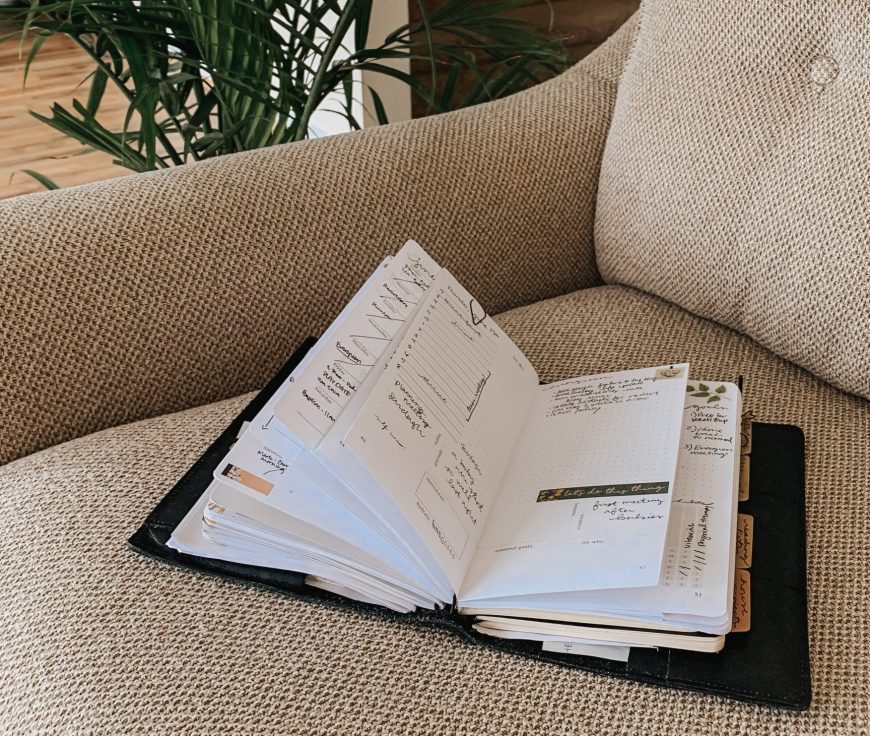
Before the Evergreen planner system, I (Clari) had never used a true day-planner. I had tried a myriad of different planners when I worked as an executive assistant before having kids, but they were the types that only had a small box, a column, or a couple of lines for each day. I also used a digital calendar to coordinate meetings and make sure nothing was double booked, but other than getting binged with meeting reminders, I didn’t really reference it or use it to effectively plan my days. My thoughts, plans and tasks were scattered among digital notes, emails, sticky notes, a half-used planner and to-do lists written on random pieces of paper.

But then I became a mom and quit my traditional job. It never occurred to me that a planner could be used to plan rest, to form life-giving family rhythms, or to plan intentional time with my kiddos—just as much as it could be used to make sure critical work projects or mundane home tasks were completed. I again wandered through my days doing what was in front of me, and working off one endlessly long to-do list.

Annie Dillard, in her book The Writing Life, wrote, “How we spend our days is of course how we spend our lives. What we do with this hour and that one is what we are doing.”

The reality is we have a lot of agency over whether we live our days intentionally, with purpose, or whether we let them pass by, moving from task to task based on emotions or a crushing sense of urgency. But we can just as easily fall into the trap of trying to squeeze every moment of productivity out of each day, neglecting our needs for rest or even the ones we’re called to love. But in order to find that middle way, we have to begin by planning each day.

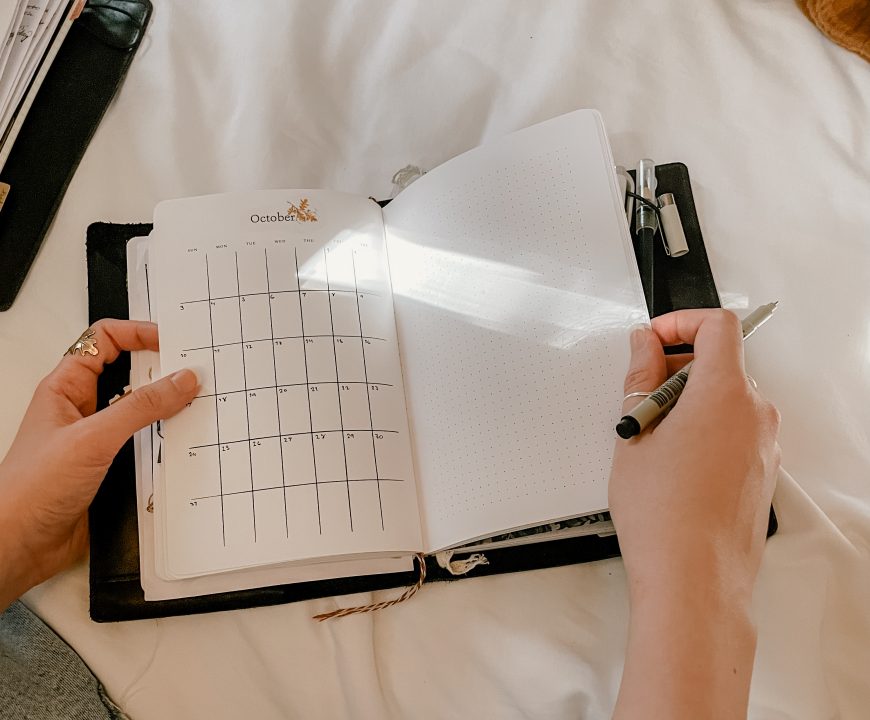
The beauty of planning each day (especially when you have an entire spread and can plan with the context of your week in view, like you can with our Monthly booklet), is that you are able to plan each day in a way that honors the season you’re in, the ones you’ve been given to love, and the work you’re responsible for.

And planning a lot of days, over several weeks and months, enables you to begin forming life-giving rhythms that work to breathe life into your family and help you make progress on those bigger goals (revisit our Four Rules of Planning and R.O.O.T.E.D. Goals episodes for more on these concepts).

In this episode, we walk through how we each plan our days on the day pages of our Monthly booklet. If you’d like to follow along, you can download our free printable below. This printable has all the major elements of our Day page, enabling you to see exactly what we are talking about as we plan the different elements of our day using the time-blocker, top targets, prompts, etc. Because it’s the tool we each use, we talk about our specific planner throughout this episode. However, the principles we talk about can transfer to a lot of different planners, so whatever planner you use, we believe this will be an episode you find valuable!

_________________________________________________

If you haven’t yet, please take a moment to rate and review this podcast or share it with a friend! It’s the best way to help other women find this life-giving content. We’re so thankful for you!

October 13, 2021

The Four Rules of Planning Part 2 – (Podcast Ep. 2)

In our second episode, we dive into the final two rules of planning: train your subconscious and maintain a flexible mindset. These concepts are simple to implement, yet extremely effective for crafting an intentional lifestyle. Listen on Apple Podcasts or Google Podcasts.

Our “Four Rules of Planning” —

  1. Write down what you did. For several days or weeks, use your planner to record what you did. By starting with the rhythms and habits you already operate in, you can recognize patterns, and evaluate what’s working and what’s not. You can then design incremental change that serves your family, makes sense for the season you’re in, and builds into a sustainable lifestyle. 
  2. Build your repertoire of planning skills. Think about it like becoming a skilled cook in a kitchen. You must build your planning and productivity skills over time, as you come upon new challenges. Learn as you go, practice patiently, and you’ll soon feel equipped to adapt your new skills to fit any given situation. Just as a skilled cook would not feel the pressure to use every technique they know every time they prepare a dish, you shouldn’t feel the pressure to exercise every single time-management or efficiency muscle you have every single moment of every day. You simply build your repertoire of skills for when you need them.
  3. Train your subconscious. The more you write down your goals and priorities, the more you are teaching your brain to focus on what is important to you. This builds a “working memory” around your priorities, enabling you to waste less energy on deciding what you need to do next in the day-to-day, so you can give more brain space to bigger goals and projects.
  4. Maintain a flexible mindset. Even with the best planning, life still throws punches and things play out in ways you could’ve never anticipated. Instead of mislabeling yourself as “failures” because of circumstances out of your control, you have the choice to strengthen your positive influence in any given situation. You can take a proactive approach to these challenges—whether big or small—by adopting a mindset that inspires you to pivot and handle the inevitable changes to your plans in creative and life-giving ways.

Remember, these rules are not a once-and-done process, they are a cycle that you can move through again and again. The truth about intentional living is that it has to be adaptable, because your life will change constantly. The schedule rhythms you were following in January are likely not the ones that will work well in September. These four rules will help you to constantly adapt, change and perfect your planning processes, while doing it in a way that is unique to your lifestyle, season and needs.

__________________________________________________

The Evergreen Planner system is comprised of three unique pieces: the Cover, the Annual and the Monthly. Here at Evergreen we believe in self-compassionate planning and want to inspire women to craft a lifestyle that both fuels their dreams and serves their daily rhythms. Learn more about our system here!

September 29, 2021

Self-Compassionate Planning + We’re Launching Our Podcast!

Planning, Pressure & Shame

When we launched our business in 2019, something caught us off guard. After years of field-testing different prototypes with ourselves and friends, we finally had our planner system on the market. The planner had become an indispensable part of our own lives, and we wanted to get it into the hands of others. Orders poured in and we were thrilled to see how other women would use this tool to fuel their goals.

But then we started getting emails and messages from women wanting to know how we thought they should spend their time. They weren’t just wondering whether they were doing this planning thing right—they were wondering if they needed to overhaul their entire lives in order to justify having bought a planner in the first place. These women were feeling both pressure to make perfect plans and shame when their days turned out differently than they imagined. Some were even feeling weighed down by the perception that their planner should look beautiful, even in the midst of their planning.

Now, don’t get us wrong, we’re down for an artful planner spread any day. And we believe there is so much to be learned from the planning community–hacks, tricks, best practices, etc. But we don’t believe that intentional living—and planning as a means to form an intentional life—has to be laden with pressure and shame. We believe quite the opposite.

Using a planner is not about super-womaning our way to an awesome life, or about forcing those around us to bend their lives to make our dreams happen. It’s not always about making a lot of money, or reaching an impressive personal goal, or cramming our life as full as it possibly can be. It’s not about making inflexible plans that don’t adapt as we go.

But we also know that giving up all of our power to be proactive is a sure path to overwhelm. We believe planning is about forming a rhythm that leads to a lifestyle that fuels realistic and life-giving goals, so that those goals can in turn breathe life into your rhythms. We’ve found this is only possible if you take a self-compassionate approach to planning.

What is self-compassionate planning? It is making the best plans you can—consistently over a lot of days—and yet having grace on yourself as you go, knowing that plans do change and that flexibility is key.

Friend, we don’t know your biggest dreams, your biggest pain points, or the goals you’ve set for yourself this year. But we’re excited to put the Evergreen Planner in your hands as a tool that you use to reach those goals.

And as for a self-compassionate mindset?

Well, we’ve got something for that too.

Our Podcast

We’re passionate about helping women craft intentional lifestyles that empower them to achieve their most life-giving goals. When our team gets together to support each other, we end up having these amazing conversations that encourage each of us to stay focused on the things that matter most.

So we decided to throw up some mics so we could share our conversations with you.

On October 4th, 2021 (that’s this Monday!), we’re launching our podcast: Make Space to Thrive.

Self-compassionate planning

Our first season will run for eight episodes, and will be available on all the major platforms.

We’ll be talking about our four rules of planning, taking a deep dive into our R.O.O.T.E.D. goals system, discussing planning while postpartum, how we plan our days & weeks and so much more. We’re so excited to share all we have learned and are learning with you all. But more than anything, we’re excited about taking some of the pressure off, and bringing encouragement to the wonderful women we have met since launching our business. This podcast is for each of you, from our hearts.

xx,

Team Evergreen

_________________________________________

Did you know you can try a piece of the Evergreen Planner system toady for free?! We want every woman to have the tools she needs to be able to begin planning intentionally, which is why we’ve created a free day planner sheet that has all of the major features of our Monthly booklet. Check it out!