Tag

practical tips

October 13, 2021

The Four Rules of Planning Part 2 – (Podcast Ep. 2)

In our second episode, we dive into the final two rules of planning: train your subconscious and maintain a flexible mindset. These concepts are simple to implement, yet extremely effective for crafting an intentional lifestyle. Listen on Apple Podcasts or Google Podcasts.

Our “Four Rules of Planning” —

  1. Write down what you did. For several days or weeks, use your planner to record what you did. By starting with the rhythms and habits you already operate in, you can recognize patterns, and evaluate what’s working and what’s not. You can then design incremental change that serves your family, makes sense for the season you’re in, and builds into a sustainable lifestyle. 
  2. Build your repertoire of planning skills. Think about it like becoming a skilled cook in a kitchen. You must build your planning and productivity skills over time, as you come upon new challenges. Learn as you go, practice patiently, and you’ll soon feel equipped to adapt your new skills to fit any given situation. Just as a skilled cook would not feel the pressure to use every technique they know every time they prepare a dish, you shouldn’t feel the pressure to exercise every single time-management or efficiency muscle you have every single moment of every day. You simply build your repertoire of skills for when you need them.
  3. Train your subconscious. The more you write down your goals and priorities, the more you are teaching your brain to focus on what is important to you. This builds a “working memory” around your priorities, enabling you to waste less energy on deciding what you need to do next in the day-to-day, so you can give more brain space to bigger goals and projects.
  4. Maintain a flexible mindset. Even with the best planning, life still throws punches and things play out in ways you could’ve never anticipated. Instead of mislabeling yourself as “failures” because of circumstances out of your control, you have the choice to strengthen your positive influence in any given situation. You can take a proactive approach to these challenges—whether big or small—by adopting a mindset that inspires you to pivot and handle the inevitable changes to your plans in creative and life-giving ways.

Remember, these rules are not a once-and-done process, they are a cycle that you can move through again and again. The truth about intentional living is that it has to be adaptable, because your life will change constantly. The schedule rhythms you were following in January are likely not the ones that will work well in September. These four rules will help you to constantly adapt, change and perfect your planning processes, while doing it in a way that is unique to your lifestyle, season and needs.

__________________________________________________

The Evergreen Planner system is comprised of three unique pieces: the Cover, the Annual and the Monthly. Here at Evergreen we believe in self-compassionate planning and want to inspire women to craft a lifestyle that both fuels their dreams and serves their daily rhythms. Learn more about our system here!


October 6, 2021

The Four Rules of Planning – (Podcast Ep.1)

Listen on Apple Podcasts or Google Podcasts

You want to start getting organized around the things that matter most to you. But where do you even begin?

In our first episode, we offer an effective shortcut for diving into the world of time-management and productivity—without getting overwhelmed. Listen above or on Apple Podcasts or Google Podcasts

Our “Four Rules of Planning” —

  1. Write down what you did. For several days or weeks, use your planner to record what you did. By starting with the rhythms and habits you already operate in, you can recognize patterns, and evaluate what’s working and what’s not. You can then design incremental change that serves your family, makes sense for the season you’re in, and builds into a sustainable lifestyle. 
  2. Build your repertoire of planning skills. Think about it like becoming a skilled cook in a kitchen. You must build your planning and productivity skills over time, as you come upon new challenges. Learn as you go, practice patiently, and you’ll soon feel equipped to adapt your new skills to fit any given situation. Just as a skilled cook would not feel the pressure to use every technique they know every time they prepare a dish, you shouldn’t feel the pressure to exercise every single time-management or efficiency muscle you have every single moment of every day. You simply build your repertoire of skills for when you need them.
  3. Train your subconscious. The more you write down your goals and priorities, the more you are teaching your brain to focus on what is important to you. This builds a “working memory” around your priorities, enabling you to waste less energy on deciding what you need to do next in the day-to-day, so you can give more brain space to bigger goals and projects.
  4. Maintain a flexible mindset. Even with the best planning, life still throws punches and things play out in ways you could’ve never anticipated. Instead of mislabeling yourself as “failures” because of circumstances out of your control, you have the choice to strengthen your positive influence in any given situation. You can take a proactive approach to these challenges—whether big or small—by adopting a mindset that inspires you to pivot and handle the inevitable changes to your plans in creative and life-giving ways.

Cozy up with this first episode, & you’ll hear:

  • A little about team Evergreen and our heart behind starting this podcast
  • Our shortcut for understanding and getting organized around your unique dynamics
  • A practical tip that helps you shift your mindset from never feeling like you’re doing enough
  • How planning is a lot like cooking—and how learning on the go is a super-effective approach

We’ll be back with The Four Rules of Planning – Part 2 next week!

Please rate & review the podcast!

It does so much to help other women discover the show.

______________________________________

To celebrate the launch of our podcast, we are giving away a Getting Started Kit (our Annual and two Monthly booklets) + our brand new 2022 Month stickers! Write a review by Friday (Oct 8, 2021) and email a screenshot of your review to helloevergreenplanner@gmail.com to enter the giveaway!

Follow us also on Instagram @EvergreenPlanner (there are ways to enter the giveaway there, too!) and Pinterest @helloEvergreenPlanner.

September 15, 2021

Planner Hack: The Amazing Paperclip

One of the biggest pain-points we personally had during the years that we were testing out #alltheplanners was simply this: it was too dang easy to get lost in your own notebook!

The most amazing brainstorming session would get lost in a moment as we moved on to fill out the next prompts and schedules, rarely to be seen again. This was annoying at best, and actually radically complicated our lives at worst when our week’s agenda was inaccessible in the moments when we needed to make quick decisions during the course of our days. We solved this problem in a big way with our innovative dutch door layout.

As we became more skilled in the use of our own planner, we began using a simple tool – a paperclip – to aid us in our ability to navigate, mark and reference various key pages. This one hack put an end to getting lost in our own planner for good, making the navigation of the Evergreen Planner a real dream. Our planner system is minimalistic, yet dynamic. We love that you can effectively use a simple ballpoint pen to get your thoughts organized on paper, or that you can just as well bust out your entire collection of microns and washi tape for beautifully curated designs.

Our paperclip hack follows that same principle that makes our planner system gold—you can go simple or you can go elaborate—either way, the functionality remains.

Here are some ideas on how to leverage the paperclip to up-level your planning game:

Bookmark this Week: A paperclip can also be used to mark the current day on your vertical week’s agenda (and hold old weeks closed).

Bookmark Today: Hold the extra day spreads closed so your Monthly easily opens up to your current day!

Secure Keepsakes: You can paperclip keepsake papers or polaroid photos to the pages of our Monthly or Annual & turn them into memory books.

Flag What’s Important: Ordinary paperclips can be customized using your favorite washi tape and they can be used to flag specific pages.

Maximize Cover Functionality: You can paperclip receipts or other bits of paper you need easily accessible onto the outside of your Cover’s pockets!

Keep Them Close: Paperclips can easily be stored on the back cover of your Monthly, ready to whip out whenever you need one!

The paperclip provides so many great advantages to the planning process. We are constantly grabbing paperclips to use in different ways, which is why we’ve curated a fun and varying collection to include in our subscription boxes.

__________________________________________________

The Evergreen Planner system is comprised of three unique pieces: the Cover, the Annual and the Monthly. Here at Evergreen we believe in self-compassionate planning and want to inspire women to craft a lifestyle that both fuels their dreams and serves their daily rhythms. Learn more about our system here!
September 8, 2021

Time-Blocking: Your Framework for Productivity

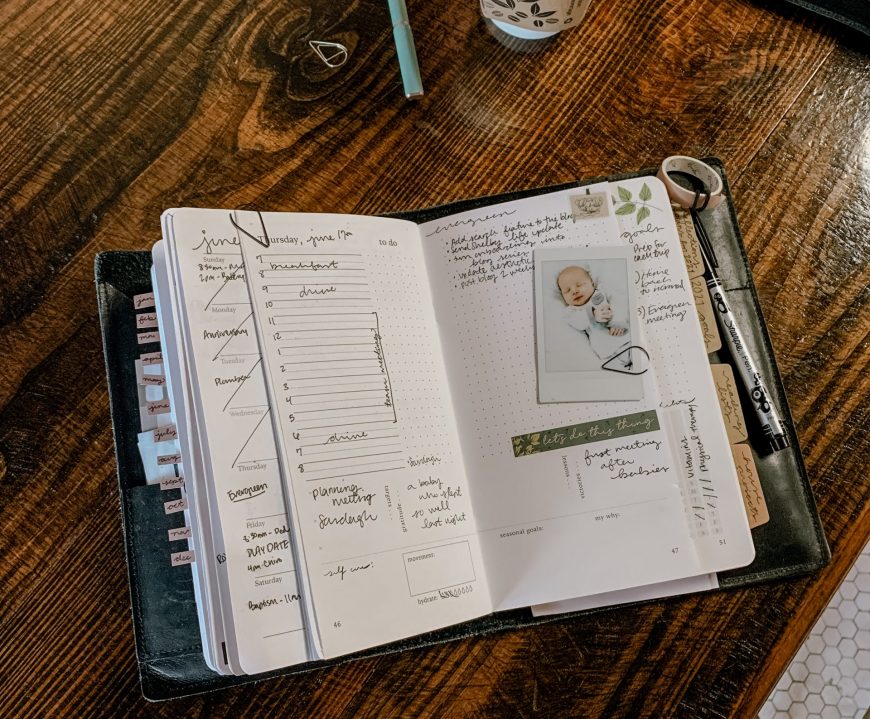
One of the most essential features in our Monthly booklets is the time-blocking section on the day spread.

When researching how to increase productivity — especially when needing to balance multiple roles in one day — there was one practical skill that came up again and again: time-blocking.

It’s highly recommended by productivity experts, and after using it in our own lives, we get why. When you make space to get realistic about your time availability, set up habits and rhythms, thoughtfully organize your tasks, apply prioritization and batching methods, and pad everything with ample margin—your productivity will increase.

With our Monthly booklet, the time-blocking feature on the day spread is completely customizable to your unique schedule. You can write in each hour to reflect your ideal rise and sleep schedule, or focus on only your working hours.

Think through your body’s energy, productivity, and rest rhythms (and for mamas, the rhythms of your kiddos). Then line out your tasks accordingly. Do you have the most creative energy first thing in the morning? Slot your most creative and important work during that time. Are you working during the day and making progress on your side hustle in the evening? Focus your time-blocking on those evening hours, writing in the key project you plan to tackle in the to-do column. Do you capitalize on your kiddos’ nap time to get work done? Slot that as your predictable working hours.

New to time-blocking?

A great way to develop this habit is to start by writing what you did do at the end of each day. Do not pass over this tip, it may seem simple, but it is a powerful tool for tracking the rhythms you already operate in. The truth is, you can’t wipe your current rhythms away and start over with a brand new schedule you think would be awesome. We are creatures of habit, and it simply won’t work. You have to begin to make change by first evaluating what you currently do, and then incrementally adjust the things that need adjusting. This will also help you see what is currently working well in the way you go about your day, and continue those life-giving habits you already have. By writing down what you did, you will be able to:

  • gauge what is realistic for you to accomplish in this season
  • spot the areas where you could use some discipline (we all have them!)
  • note the days or hours you tend to run errands, plan appointments or take care of home tasks
  • chart out the natural rhythms you (& your family) already operate in (meals, naps, school, work, etc.)

A few days (or even weeks) of this, and you will have loads of insight you can then use as you start to plan days before they happen. The practice of writing down what you did is a trick you can pull out again and again whenever you hit a season of transition (new job, new baby, new home, etc.). When things feel a little off, just take a few days to evaluate your rhythms and see what insights you can gain about what is working and what needs changed.

If you’ve never made a habit of time-blocking, start today! Flexibility is always required, but you’ll be amazed at how much time-blocking will enhance productivity. It’s the gift that just keeps giving.

Want to keep it fun? Highlighters, colored pencils, or even washi tape can be great ways to visually track the different sections of your day.

__________________________________________________

The Evergreen Planner system is comprised of three unique pieces: the Cover, the Annual and the Monthly. Here at Evergreen we believe in self-compassionate planning and want to inspire women to craft a lifestyle that both fuels their dreams and serves their daily rhythms. Learn more about our system here!