Tag

makespacetothrive

April 21, 2021

Creating Intention Lists

One of the main benefits of using a planner on a daily basis is the resulting automation of thought processes.

Automating thought processes can do so much to free up mental bandwidth and reduce decision fatigue (did you know that was a thing?!).

On our day spreads, we have our regular prompts which lead you through a set of intention-strengthening exercises: “What are your top targets for the day? What are you thankful for? What are your seasonal goals and why are they so important?” etc.​

But there’s so much space in your planner system to make it serve you in unique and powerful ways. One of the ways to automate your own, personal thought processes is to develop a series of “Intention Lists.”

Creating Intention Lists

Shelby developed her “intentions” lists by asking herself the following questions:

  • How do I “re-invent the wheel” in the normal processes of my everyday life?
  • When do I rethink and rewrite the same things, over and over?
  • What if I had a reference list for all of the basics of maintenance, so that I could reserve my creative energies and memory power for things that will help us grow?

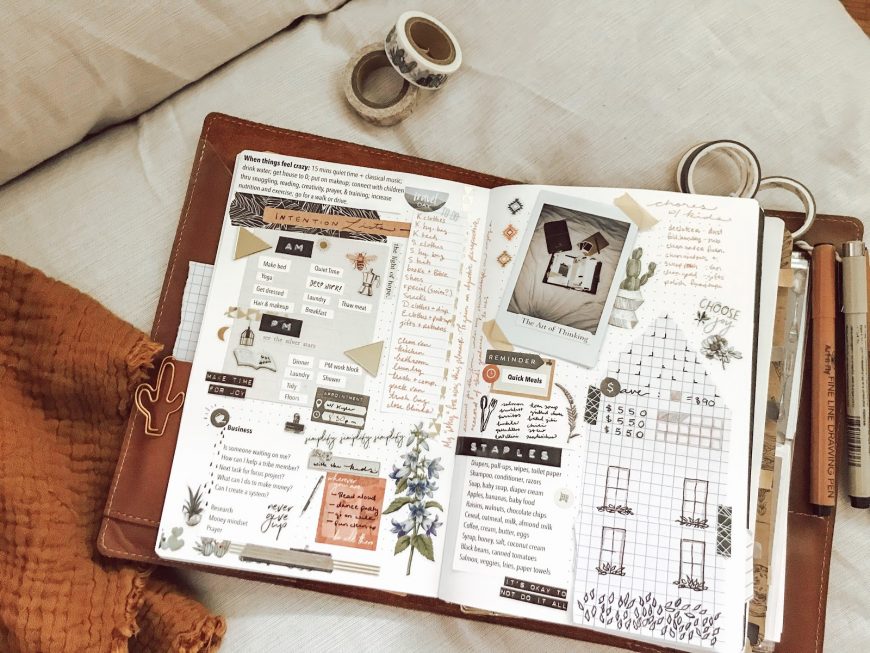
She typed out a series of lists based on anything and everything in her life that was on repeat: morning rhythms, evening rhythms, sitting down to work, preparing to travel, getting dinner on the table in under 30 minutes, running to the store to restock the basics, things to do with the children that would cultivate teamwork and connection, and ideas for what to do to reset when everything just felt crazy.

For the longest time, all of these lists sat typed out on a regular piece of paper, tucked in the front pocket of her Cover. She referenced them frequently in her daily living, and they saved her a significant amount of time and effort.​

These “Intentions Lists” seriously passed muster, so Shelby awarded them with a permanent place in the front pages of her Annual.

Here’s the breakdown of some of the exact lists I use:​

Morning Rhythm:
  • make bed
  • yoga
  • get dressed
  • hair + makeup
  • quiet time
  • DEEP WORK
  • laundry
  • thaw meat
  • breakfast
Evening Rhythm:
  • dinner
  • laundry
  • tidy house
  • floors
  • PM work block (in hustle seasons)
  • shower
  • time with Kyle
Business Check-In:
  • Is someone waiting on me?
  • How can I help a tribe member?
  • Next task for focus project?
  • What can I do to make money?
  • Can I create a system?
  • Do I need to research anything?
  • Do I need to work on my money mindset?
  • What do I need to pray about in the business?​
Travel Packing & Prep:
  • Kyle’s clothes
  • Kyle’s hygiene bag
  • Kyle’s tech bag
  • Shelby’s clothes
  • Shelby’s hygiene bag
  • Shelby’s tech bag
  • books + Bible
  • shoes
  • special wear (swim? cold?)
  • snacks / food
  • David’s clothes + diapers
  • Elizabeth’s clothes + pull-ups
  • gifts and returns
  • clean out the van
  • clean kitchen
  • clean bathroom
  • finish laundry
  • trashes + compost
  • pack van
  • fresh trash bags
  • fresh towels
  • close blinds
Connecting with the kids:
  • read aloud
  • dance party
  • go on a walk
  • fun clean-up
  • make gifts
Chores with the kids:
  • declutter
  • dust
  • fold laundry
  • scrub tub
  • clean under furniture
  • clean windows + mirrors
  • sweep porch
  • clean out van
  • clean yard
  • polish furniture

If reclaiming precious time and decision-making energy sounds amazing but you don’t have time to decorate a spread like the one above, don’t complicate it! Just type up or jot down basic lists and tuck them into your Cover to reference as needs be, and then edit them as you use them!

_______________________________________

Are you ready to launch into an entirely new way of planning? We created the Evergreen Planner System because we needed a tool that would help us not only track all our day-to-day responsibilities, but also be a complete hub for our brains, a place to catch lists and notes of all sorts. It has become something we can’t live without! The Getting Started Kit is the perfect way to try two of our core products – the Annual and the Monthly. Don’t wait until we launch our next subscription box – get the tools you need today!
April 14, 2021

How to Stop Wasting Time on Screens

Last week, we asked this question:

What are the most overwhelming areas of my life? If I were proactive in these areas (instead of operating in a default, reactionary state), how could I clear the excess and focus on what matters most?

In this post, we’re going to get really practical and tactical.

Understanding the (Designed) Problem

I used to think my life was overwhelming by default, and that I simply didn’t have enough time and mental energy to do everything I believed I was called to do. I didn’t sit around and watch TV, and I’d even turned all of the notifications off on my phone, but I still found the days to be far too short. But I’ll never forget the sucker punch of conviction I felt when I was standing in my kitchen, peeling potatoes, and listening to Greg McKeown (author of Essentialism) tell Allie Casazza in an interview:

“Pick up your phone and don’t get distracted by it…. [Look at your screentime usage]…. Now this is one tiny but factual resource for how people are spending time…. You can’t believe it, can you?…. But you could be above average in today’s world and still, in fact everyone is, still sucked into nonessentialism. This is the power of nonessentialism. It’s everywhere. And it’s not everywhere by default, it’s everywhere by design.”

If you find yourself overwhelmed by the constant stimuli of your electronic devices and yet unable to live without them, you’re taking part in what’s becoming the universal anxiety of the developed world. 

“People don’t succumb to screens because they’re lazy, but instead because billions of dollars have been invested to make this outcome inevitable…. we seem to have stumbled backwards into a digital life we didn’t sign up for…. it’s probably more accurate to say that we were pushed into it by the high-end device companies and attention economy conglomerates who discovered there are vast fortunes to be made in a culture dominated by gadgets and apps.”​ — Cal Newport, Digital Minimalism

Here’s the thing about technology and our precious time: our devices are amazing tools that can be used in powerful ways to help us become time-efficiency-ninjas. But every screen you own is also battlefield for your time and attention. The tech industry has invested untold amounts of cash into consulting with brain scientists to take advantage of user psychology and break down the natural mental boundaries that protect our intention and our focus. This is not a conspiracy theory—it’s a well-documented fact. Many popular apps interact with your brain’s dopamine loop, delivering unpredictable rewards and duds at just the right balance, so that it addicts you in much the same way playing slot machines would. Their #1 objective is to keep you on their app, and to keep your focus fragmented enough that you keep scrolling and tapping, consuming more information, and depositing your own data into the app so they can track your interests and optimize your advertisements.

“You have a business model designed to engage you and get you to basically suck as much time out of your life as possible and then selling that attention to advertisers.” — Sandy Parakilas, former Facebook employee

And that’s the key right there—the advertisements. This digital battlefield is called “the attention economy,” and these companies who are deliberately engineering medically addictive apps are coming under a lot of fire, even in mainstream conversations

And while solutions to the unethical aspects of all of this ought to be found, I want to zero-in on the one thing you absolutely can control: your personal responsibility as a consumer in the attention economy.

A New Approach to Technology

Here are some enduring principles and strategies to empower you as you navigate this uncharted territory:

  • You have personal responsibility and power over how you spend your time. You may have been pushed into an addiction because you never realized the way these apps were engineered to monopolize your time, but now that you have the power of knowledge, you have the responsibility to take your time and attention back. You don’t have to give into impulses, you can decide how much of your mental bandwidth you’re willing to sell to these platforms, you can set up strong boundaries, and you can take charge of your days.
  • You don’t have to believe that all technology is evil to become more intentional. Anyone could recite a hundred ways that technology (and even social media) have benefited them. There’s a lot to be gained from being connected to a global marketplace, having immediate channels of communication, and enjoying open access to quality information. Technology is an incredible toolkit. But each tool in the kit must be used with intention
  • Your approach to technology should always support your overarching goals and never distract from them. Your overarching goals need to be clear to you (journal them out!), and each technological habit and activity needs to be carefully evaluated for how well it supports those goals. Even slower, long-form media like podcasts can be overwhelming you with information and giving your brain zero bandwidth to process the information that’s already loading it down. Taking an extended break from social media, video streaming, email lists and loops, and other non-essential screentime habits can help bring a lot of clarity to what is actually advancing your goals (especially if it’s long enough to break addiction cycles and detox effectively—Cal Newport recommends 30 days.)
  • You should trade techno-maximalism for an essentialist approach when it comes to technology. Digital Minimalism, a critical book by Cal Newport, radically changed the culture of our home (for the better) in under a week. My husband has this section underlined: “[After the digital declutter], for each technology that you’re considering reintroducing into your life, you must first ask: Does this technology directly support something I deeply value? This is the only condition on which you should let one of these tools back into your life. The fact that it offers some value is irrelevant—the digital minimalist deploys technology to serve the things they find most important in their life, and is happy missing out on everything else.” Start by turning off all notifications (banners, badges, and popups) and setting aside time in your day and week to be completely unplugged (e.g. charge your phone in a different room when you sleep, consider taking a break from social media on Sundays, stop sharing homeschooling photos on Instagram during school hours, etc).
  • You don’t owe your friends and extended family anything via social media. Healthy relationships have healthy boundaries, and personal growth is mutually supported. If you want to take a step back so you can become radically intentional about your social media usage, you’re not harming anyone by no longer sharing your thoughts digitally, by missing the life updates delivered publicly, or by foregoing posting your children’s photos so that they show up in your family members’ feeds. Your friends and family members may react in a confused or negative way, but you can gently communicate that you’re taking a break from social media to reevaluate your priorities.

A Practical Approach

You can leverage the power of habit to reverse the negative effects of hyperconnectivity starting today.

Here’s my personal strategy for beating screen addiction and cultivating a technological space that drives my goals forward instead of distracting me from them.

  • Firstly, I engage in technology fasts frequently. I clear the mental and emotional clutter by avoiding every single digital tool and platform that isn’t necessary for me to do my job (and then I put strict time limits on when I can engage the tools I am required to use for work).
  • Secondly, I optimize my digital work landscape in order to streamline and protect my focus. I use the power of habit to do so. Habits are a three-part automation: the cue, the activity, and the reward. (Engineers use this to addict you to their apps: a notification is the cue, the social interaction on their platform is the activity, and the dopamine response is the reward.) I often set a timer for five minutes and engage in this cycle—but I use it to the advantage of my future focus. Here’s how: I open my work environment and let the first thing that catches my eye (the cue) direct my attention. Then I skim the content and ask Cal Newport’s question: “does this [content] directly support something I deeply value [in my business]?” If the answer is not a resounding “YES!!,” then I immediately unsubscribe or unfollow (the activity). Then I visualize all of the mental bandwidth I just freed up to focus on things that do matter to me and lean into the empowered feeling that comes along with exercising self-control (the reward). Using this strategy, I’ve found that decluttering itself can become addictive. But unlike the overwhelm that comes with maximalism, an essentialist approach vastly improves your quality of life by putting you back in charge of your time and attention. Once my timer goes off (it’s important that it’s only five minutes long so I don’t start experiencing decision-fatigue), my intention-muscles feel stronger and I can dive into the task I sat down to do. 

Use your planner to timeblock the following things: your responsibilities, space for engaging in the deep work needed to advance your most important goals, ample time for in-person relationships, adequate rest and self-care, and then pad everything with margin. Then see how much time you have leftover for optional tech habits. When I did this exercise, I found that I had about four hours per week that could even reasonably go to social media. And then I thought about what else I could do with four hours per week: I could write more, read more, or spend more time outside. The allure of social media dampened considerably as I imagined how it felt to use all of my discretionary time scrolling versus getting out to hike with my kids or curling up next to my husband with a good book.

You may have unwittingly been a target of the engineers of technology in the past, but now that you understand what’s happening, you have a choice to make. You will never get back the minutes and hours spent in a mindless scroll. Become ruthlessly honest with yourself. Get Cal Newport’s book. Fast from social media for a season and deeply relish the time with your family. Ask the Lord to help you overcome any addictions that strip you of your power to be intentional. Connect to your core calling and show up as a leader in your own life. You got this.

__________________________________________

Are you ready to launch into an entirely new way of planning? We created the Evergreen Planner System because we needed a tool that would help us use the time we’ve been given intentionally, and it has become something we can’t live without. The Getting Started Kit is the perfect way to try two of our core products – the Annual and the Monthly. Don’t wait until we launch our next subscription box – get the tools you need today!

April 7, 2021

How to Stop Wasting Time by Taking a Second to THINK

Last week, we wrote about the importance of having the proper perspective when it comes to valuing time. If you haven’t had a chance, it’s worth reading right now.

For many of us, time-wasting doesn’t look like one would expect. We’re not laying around on the couch all day every day, eating Cheetos and watching reruns. We’re actually really busy—always going, doing, hustling, and racing from one thing to the other. That’s how we feel, anyway, and the result all too often does look like Cheetos-and-reruns-on-the-couch for a lot longer than we think is healthy, because we feel too worn out to do anything else with our pockets of free time.

It’s the typical song and dance of our busy culture.

But what if a large amount of our busy-ness itself is the drain on our time? What if we’re needing to say “no” more often, so that our “yes”-es have the space to breathe and really flourish? How do we gauge the quality of our busy?

Each of us will have to answer this question individually, and each of our templates for evaluating will look a little differently. That’s because we each have different giftings to edify the Body, and different areas of the garden that we’re called to cultivate.

We need to take a second to ask these questions:
  • What are the most overwhelming areas of my life? If I were proactive in these areas (instead of operating in a default, reactionary state), how could I clear the excess and focus on what matters most?
  • What are my top priorities—the “non-negotiables” on my plate? Who and what must I show up for with commitment and thoughtfulness, even if it means other things have to go unmanaged
  • What work has God given me to do in His world? He’s ‘got the whole world in His hands, and He doesn’t need me to have every last detail figured out. So what is the unique role He created me to fill—the space where I’d be the hardest to replace?

Your life is too precious to let it drain away in the exhausting hamster wheel of reactionary living. Use the flex space of your planner to get still and think deeply. There’s a lot of joy to be found in your corner of the garden.

__________________________________________

Are you ready to launch into an entirely new way of planning? We created the Evergreen Planner System because we needed a tool that would help us use the time we’ve been given intentionally, and it has become something we can’t live without. The Getting Started Kit is the perfect way to try two of our core products – the Annual and the Monthly. Don’t wait until we launch our next subscription box – get the tools you need today!

March 31, 2021

How to Stop Wasting Time: Perspective

Stop for just a second and ask yourself: what is a week of your life actually worth?

We only have 4,452 weeks from the moment we’re born until our 85th birthday (if we’re given that many years).

Just…let that sink in. We have fewer than 5k weeks in an entire (generous) lifespan, and yet, sometimes we just let a “bad” or “off” week (or several) slip away without seriously evaluating underlying causes and lessons we could be learning.

Now, don’t misunderstand: sometimes a week that’s way more heavy on rest, fun, or flexibility is needed. Sometimes, crises (internal and external) endow a week with a heavenly purpose that we cannot immediately grasp from our point of view in the moment.

But are we really grasping that there are only 936 weeks from the moment our child takes her first breath to the day she’s graduating highschool? That we have only 156 weeks we get to invest into the hungry mind of our toddler before his little brain networks solidify? That in just 520 weeks an entire decade of marriage is in the books? 

Are we really grasping the fact that this upcoming week is either laying another brick in the foundations of the future we’re called to help build—or that it’s stuffing the foundations with wood, hay, and stubble, and all manner of things that (thankfully) will not last in the refining fires of God’s redemption?

How quickly the weeks just tick away on our calendars.

This post is in no way designed to inspire fear: we cannot attack time with a death grip and try to slow it down or expect it to develop our personal histories exactly as we wish. However, we are called to accept the reality that time is the most precious resource we are called to steward. Unlike money or energy (two things we tend to be wayyyy more careful about spending), time is not renewable. A week that passes can never be brought back again. This week, once lived, becomes part of our personal (and family) history.

While we have eternity in Christ to explore His creation, expressing ourselves creatively as an amen to His Image in us, and basking in the goodness of communion with and in Him—our time on this side of glory is much more limited (and yet endowed with eternal purpose).

We have a finite number of weeks to walk the earth and advance the oasis of Christ’s joy into the desert, to invest rare love into hungry hearts, and to respond to temporal needs with creativity. We have a finite number of weeks to advance the cause of Christ to a world in such desperate need of His mercies.

In our modern world, being “short on time” seems to be an unquestioned constant. But we are not any shorter on time than in any other era of history. Instead, our life expectancy is better than it’s been for millennia. Our homes and garages are stocked with machines that save so much time that it would absolutely boggle the minds of our ancestors. Speed of transportation is unprecedented, and speed of communication is immediate.

Our problem is not a shortness of time, but a confusion of our priorities. 

Evaluating Your Time Exercise & Worksheet

Take some time to journal through the following questions & complete this worksheet.

  • How exactly are you investing our weeks?
  • If we were to map out an average week, what areas of life get most of our attention?
  • Is our schedule packed to the gills with extra drive time?
  • Are we devoting the majority of our time dropping everything and responding to the boundary-less “emergencies” of others?
  • Does mindless scrolling get the best hours of our week?
  • Are our current priorities, events, projects, screentime activities and conversations worth the precious time out of our week that they’re claiming?
  • Are more important things consistently being de-prioritized in response to the tyranny of the urgent, digital distractions, or a reactive lifestyle that’s been slapped together haphazardly?

It can be difficult to honestly evaluate how we have spent our time, but it can also be the exact catalyst needed to make us make the necessary changes. How you spend your moments is how you spend your life. Make sure you’re truly making space to thrive.

__________________________________________

Are you ready to launch into an entirely new way of planning? We created the Evergreen Planner System because we needed a tool that would help us use the time we’ve been given intentionally, and it has become something we can’t live without. The Getting Started Kit is the perfect way to try two of our core products – the Annual and the Monthly. Don’t wait until we launch our next subscription box – get the tools you need today!